2 September 2026 · 6 min read
Where to dump concrete in Brisbane, and when you should not
Dumping concrete is the right answer for a small load and the expensive answer for a big one. How to tell which job you have before you book trucks.
Written by Colin Luckman, Founder and operator. Twenty years in the recycling industry, running mobile crushing on civil and demolition sites across South-East Queensland and New South Wales.
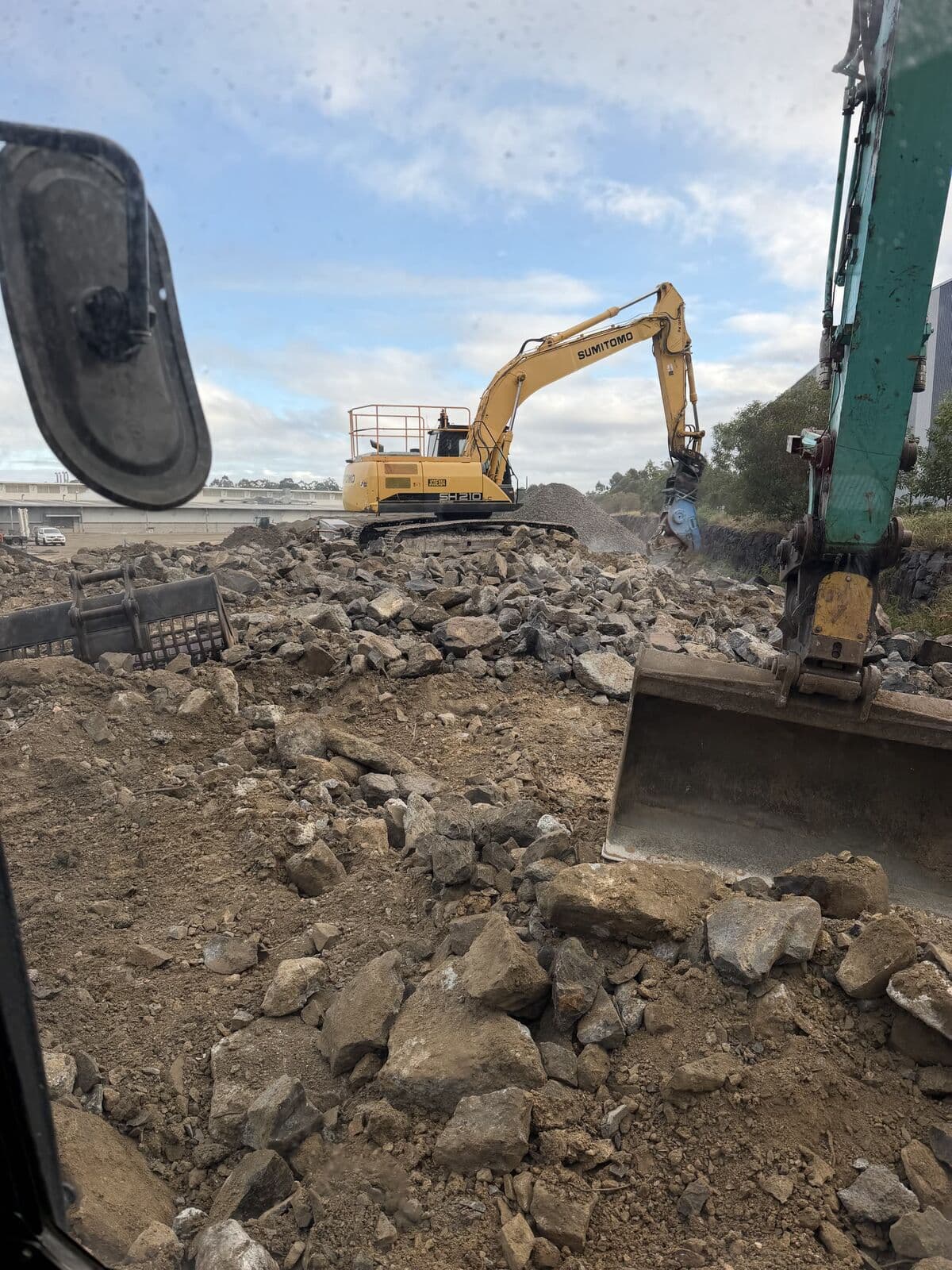
If you have concrete to get rid of in Brisbane, the obvious move is to find somewhere to dump it. For a driveway or a few footings that is exactly right, and this article will tell you what to expect. For anything larger it is often the most expensive option available, and the reason is not the tipping fee. It is the trucks.
We run mobile crushing, so we have a side in this. We have tried to be straight about where dumping is genuinely the better answer, because on small jobs it usually is.
What it costs to dump concrete in Brisbane
Three separate costs make up the total, and only one of them appears on the docket you get at the gate.
- The gate fee, charged per tonne by the receiving facility.
- The Queensland waste levy. Brisbane is in the metropolitan zone, where the general waste levy is $135 per tonne for the 2026-27 financial year. Ask whether a quoted gate fee includes it or sits on top, because both are common.
- Cartage. Truck hire, driver hours and fuel for every load, both directions.
People estimate the first, forget the second and badly underestimate the third. Cartage is the one that scales with volume in a way that catches jobs out, because it arrives weeks later as a plant hire bill rather than as a number anyone quoted up front.
The question that decides it: how many truck movements
Work out roughly how many loads you are looking at. A truck and dog carries in the order of 25 to 30 tonnes depending on configuration, so a few hundred tonnes of slab is not a handful of trips, it is a fortnight of them. Then think about where the receiving facility is relative to your site, at the time of day your trucks will actually be running.
A yard twenty minutes away on a map can be an hour each way through Brisbane traffic with a queue at the gate on top. Every one of those minutes is on hire. This is why two jobs with identical tonnage can have completely different disposal bills: it is not the fee, it is the round trip.
When dumping is the right answer
Be honest about your own job. Dumping wins in three situations, and a mobile operator who tells you otherwise is selling.
- Small volumes. A residential driveway, a shed slab or a few footings will never carry the cost of bringing plant to site. Put it in a truck.
- Mixed or dirty material. Concrete tangled through timber, plasterboard, insulation or soil is not crusher feed, and separating it on a cramped site can cost more than carting it out.
- No room to work. A crusher needs somewhere to stand, room for an excavator to feed it and space to stockpile the product. Some inner-city sites simply do not have it.
When dumping is the expensive answer
The picture flips when you have a decent quantity of clean hard material, room to work, and a job that is going to buy road base at some later stage. In that case you are paying to remove a material and then paying again to import its replacement, with the levy and the trucks charged in between.
Crushing on site removes all three of those costs at once. The material never goes to a facility, so no gate fee and no levy. It never leaves the site, so no cartage. And what comes out the other end is the road base you were about to buy. Feed has to be clean hard material: concrete, brick, rock and asphalt crush well, and reinforcing steel is expected and removed as part of the process.
Our RM 70GO! 2.0 travels on a standard float with no oversize classification, permits or escorts, and is crushing within about twenty minutes of arriving. Output is graded in the machine to road base, drainage gravel and 5 mm or 10 mm aggregate, and every tonne is weighed on the onboard belt scale.
A rough way to work out which one you have
Ask three questions. Is the material clean and hard, or is it mixed through with soft waste. Is there enough of it in one place to be worth a machine visit. Is there somewhere on site to stand a crusher and stockpile the output. Three yeses and it is worth getting a crushing quote before you book trucks. A no on any of them and the yard is probably your answer.
If you are not sure how much material you have, tell us the footprint and thickness of what is coming out and we will estimate the tonnage with you. It costs nothing to find out, and it is a better use of ten minutes than discovering the cartage number after the job has started.
We have also written about how the two kinds of concrete recycler differ and what to ask each of them. Choosing a concrete recycler in Brisbane.
Common questions
- Where can I dump concrete in Brisbane?
- Concrete goes to a recycling yard or a licensed receiving facility rather than general landfill, because clean concrete is a recoverable material. Expect to pay a gate fee per tonne, and check whether the Queensland waste levy is included in that figure or added to it. For larger volumes it is worth comparing the total, including cartage, against crushing the material on site instead.
- How much does it cost to dump concrete in Brisbane?
- Three costs make up the total: the gate fee per tonne, the waste levy, which is $135 per tonne in the metropolitan zone for 2026-27, and the cartage. Cartage is usually the one that is underestimated, because it scales with the number of truck movements rather than with the tonnage on the docket.
- Can I dump concrete with reinforcing steel in it?
- Generally yes. Reinforcing steel is expected in demolition concrete and is removed during processing, whether that happens at a yard or on your site. What causes problems is soft contamination such as timber, plasterboard, plastic and soil, which is the usual reason a load is rejected or charged at a higher rate.
- At what point is crushing on site cheaper than dumping?
- There is no single tonnage that applies to every site, because the answer depends on how far the receiving facility is, how clean the material is and whether there is room to work. The practical approach is to describe the job and get both numbers, with cartage included on the dumping side, since that is the line that usually decides it.
Related reading
13 July 2026 · 6 min read
Concrete disposal in Brisbane: options and real costs
Concrete disposal in Brisbane: tip, skip or on-site crushing as low as $8 per tonne on higher-tonnage jobs. What each costs in 2026 and how to choose.
2 September 2026 · 7 min read
Choosing a concrete recycler in Brisbane: what to ask before you book
Concrete recyclers in Brisbane work in two completely different ways, and the cheaper one depends on your site. The questions that decide it.
24 June 2026 · 5 min read
Brisbane tip fees for concrete: the 2026 waste levy explained
Brisbane tip fees plus the 2026-27 Queensland waste levy of $135 per tonne, what concrete really costs to dump, and when crushing on site is cheaper.