
24 June 2026 · 5 min read
Carting concrete vs crushing on site: the real cost numbers
SEQ tip fees exceed $80 per tonne. The carting vs on-site crushing cost comparison, with crushing as low as $8 per tonne on higher-tonnage jobs.
Written by Colin Luckman, Founder and operator. Twenty years in the recycling industry, running mobile crushing on civil and demolition sites across South-East Queensland and New South Wales.
Here is a number that should bother every civil contractor, demolition crew, and site manager in South East Queensland. Tip fees in Brisbane now exceed $80 per tonne for clean concrete. That is before you pay for trucking. Before you pay for new aggregate on the way back. Before you factor in the downtime while your excavator waits for the next float. Every truckload of concrete you send to landfill costs you on the way out AND on the way back.
The Two-Way Ripoff
Traditional concrete disposal works like this. Outbound cost: you pay a truck to haul demolition concrete to a tip or recycling facility and you pay the tip fee at the gate. Inbound cost: you pay another truck to bring clean aggregate back to site for fill, sub-base, or road base. You paid twice for material you already owned.
A 500-tonne demolition project at current SEQ rates: tip fees 500t times $80 equals $40,000, trucking out around $6,000, trucking in new aggregate around $6,000. Total: approximately $52,000.
On-Site Crushing: The Flip
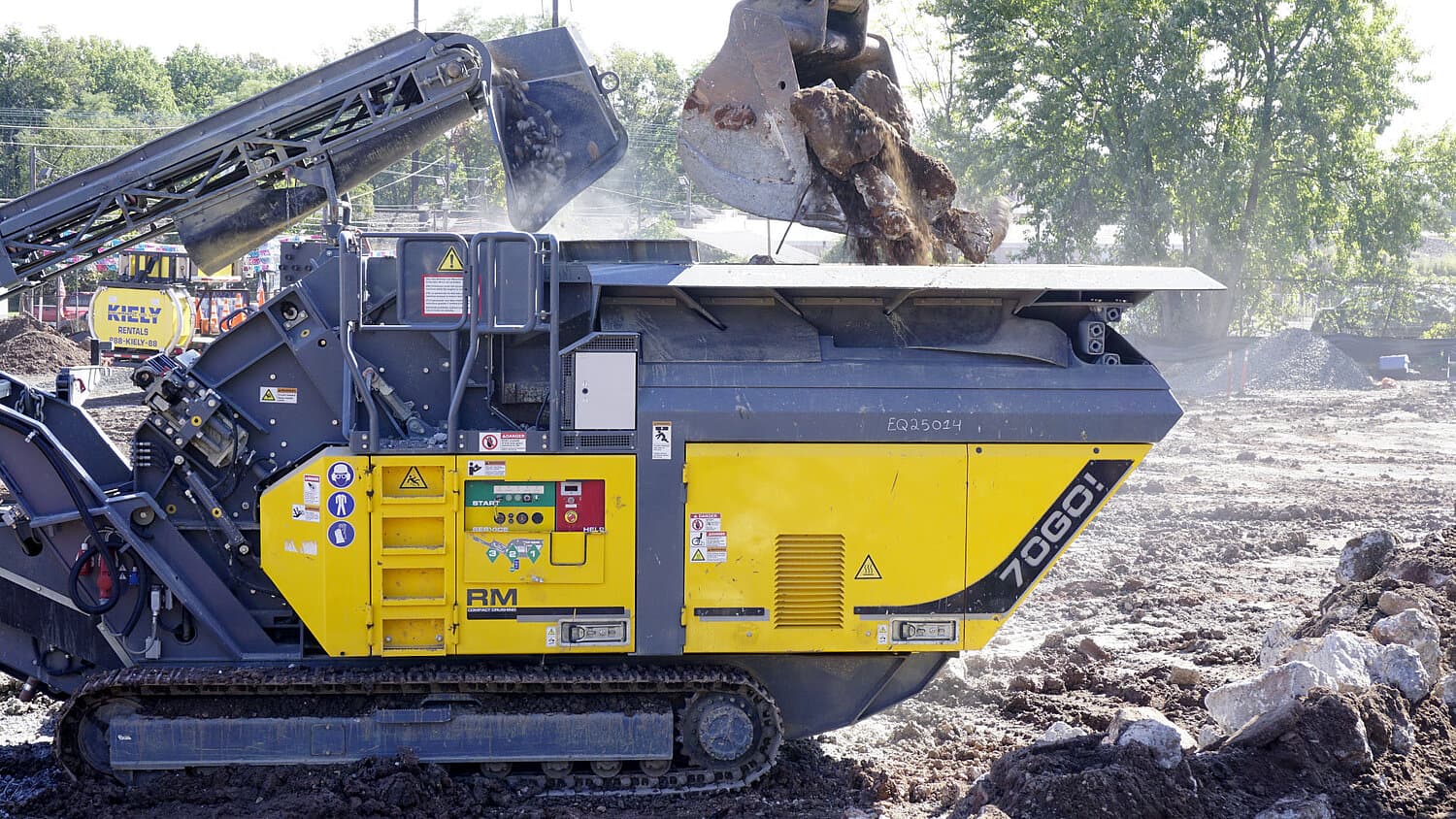
The RM 70GO! 2.0 impact crusher processes up to 140 tonnes per hour and grades to 5 mm or 10 mm spec on the spot. Clean demolition concrete goes in. Road base comes out. The product stays on your site.
Same 500 tonnes, crushed on site: crushing at as low as $8 per tonne equals $4,000, fuel and mobilisation around $2,500. Total: approximately $6,500. That is $45,500 saved on a single project.
What About Mixed or Oversized Material?
This is where the two-stage setup earns its keep. The Komplet Krokodile shredder tears through oversized slabs, embedded rebar and heavily reinforced demolition concrete that most operators turn away. The RM 70GO! 2.0 follows behind, crushing the pre-processed material to spec. No double-handling. No sorting delays. One continuous process, one operator, one product stockpiled where you need it. Reinforcing steel is liberated and separated during crushing. It goes to scrap. The concrete becomes your road base.
What You Can Actually Save
The numbers shift based on tonnage, access, and material type. But the pattern holds. A 100-tonne job saves around $8,800 versus traditional disposal. A 500-tonne job saves around $45,500. A 2,000-tonne job saves around $186,000. These are based on real jobs across Brisbane, Ipswich, Logan, the Gold Coast and Toowoomba, billed on actual production via the RM 70GO! 2.0 onboard scale.
Why Most Contractors Still Cart It Away
Habit. The old way is familiar: order a float, fill it, send it. The new way requires one phone call before the job starts. The RM 70GO! 2.0 arrives on a standard float. No oversize permits. No escorts. Setup takes about 20 minutes. Your excavator feeds it. Your crew uses the product. You skip the tip entirely.
The Environmental Side
On-site crushing is not just cheaper. It reduces truck movements to and from landfill. Your demolition concrete becomes your road base, the same material in a different form. For projects with environmental management plans, sustainability reporting, or council approval conditions, on-site crushing is a compliance win that also saves the budget.
What to Do Next
Tell us the site location, the material type, and roughly how much you have. We come back with a firm price, not a range. Our quotes start from $8 per tonne on higher-tonnage jobs. A real person responds. No call centre. No sales script.
Not sure yet whether your job is a crushing job or a carting job? Work through the on-site crushing vs carting decision guide.
The hidden costs in this article are easiest to see side by side, so run your job through the crushing cost calculator.
Call 0401 803 662 or request a quote online. Stop paying twice for your own material.
Common questions
- How much does it cost to cart concrete to the tip in South East Queensland?
- Tip fees for clean concrete in Brisbane now exceed $80 per tonne, and that is only the first of three charges. You also pay a truck to haul the material out, and then pay again for replacement aggregate to be trucked back in for fill, sub-base or road base. On a 500-tonne job at current South East Queensland rates, that stacks up to roughly $40,000 in tip fees, about $6,000 trucking out and about $6,000 trucking new material in, or around $52,000 in total.
- How much can on-site crushing save on a 500-tonne job?
- Crushing the same 500 tonnes where it sits costs in the order of $6,500, made up of production from as low as $8 per tonne on higher-tonnage jobs plus fuel and mobilisation of around $2,500. Against roughly $52,000 for the carting route, that is about $45,500 saved on a single project, and you finish with the road base on your job rather than a hole in the budget. Recycling King bills on the RM 70GO! 2.0 onboard belt scale, so you pay for what was actually produced rather than an estimate.
- Can reinforced or oversized concrete be crushed on site?
- Yes. Recycling King runs a two-stage setup for material that most operators turn away. The Komplet Krokodile shredder handles oversized slabs and heavily reinforced demolition concrete, and the RM 70GO! 2.0 follows behind to crush the pre-processed material to a graded product. Reinforcing steel is liberated and separated during crushing and goes to scrap, so rebar is not a reason to send concrete to landfill.
- Is there a minimum tonnage before crushing on site makes sense?
- Below roughly 20 tonnes, a skip or a removal contractor is usually the cheaper answer, because a crusher cannot pay for its mobilisation on that volume. Concrete is heavy, at around 2.4 tonnes per cubic metre, so skips reach their weight limit long before they look full. Above that threshold the arithmetic turns quickly, and Recycling King will tell you if carting is genuinely the better call for your South East Queensland job.
Related reading
20 August 2026 · 6 min read
Concrete recycling Sunshine Coast: costs and on-site crushing
Concrete recycling on the Sunshine Coast, priced from as low as $8 per tonne on higher-tonnage jobs. What disposal costs once the levy and the Bruce Highway run are counted.
24 June 2026 · 5 min read
Concrete crushing Gold Coast: on-site recycling costs
Gold Coast tip fees and trucking costs are climbing. On-site concrete crushing keeps demolition material on the job and skips the Coomera tip queue.
26 May 2026 · 6 min read
On-site crushing or carting to the tip: a decision guide
A decision guide for civil and demolition jobs across SEQ and NSW: when crushing concrete on site beats carting it away, and when carting still wins.